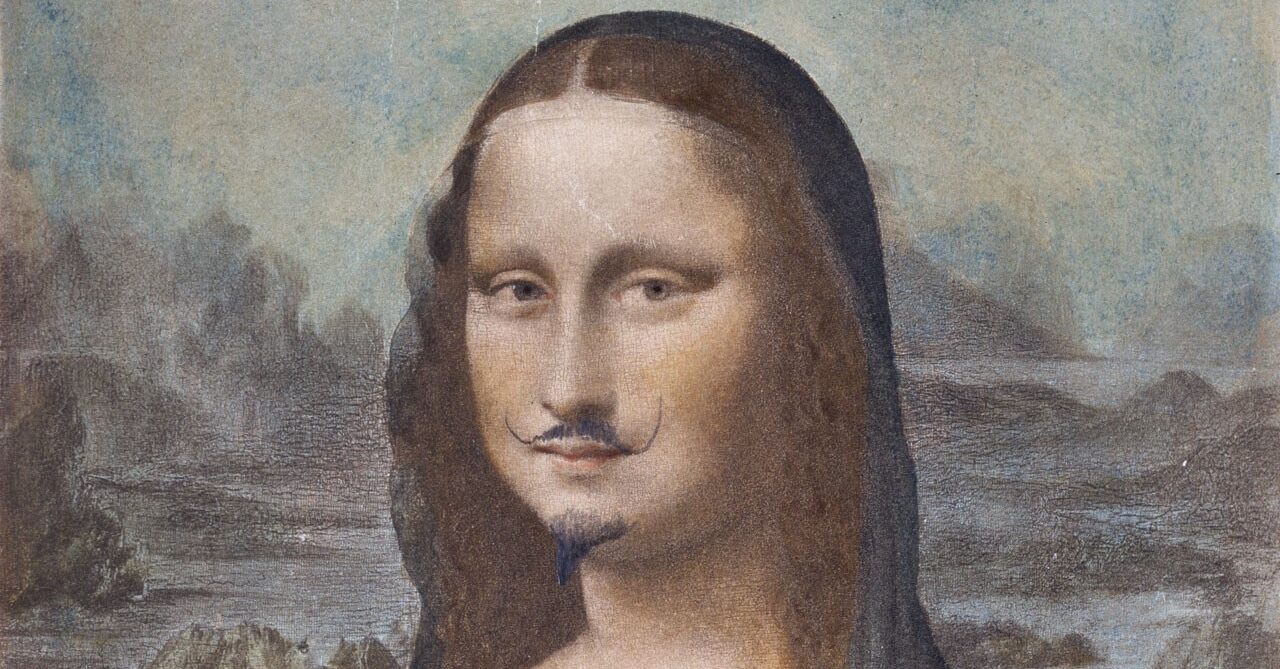
Towards the beginning of this lecture I tell you about Schoenberg’s SkandalKoncert in 1913. Pause the lecture and check out one of the pieces performed at the concert, by the composer Alban Berg, and see what you think:
And in order to give you a bit more time to get the textbook, I will give you PDF’s of the readings for the first couple lectures. Here are the chapters for this first lecture (SHOCK):
1914 (only the section on Duchamp, pages 139-41)

This entry is licensed under a Creative Commons Attribution-NonCommercial-ShareAlike 4.0 International license.


111111111111111111111
The 1914 pieces of art were really cool and unique to see, especially the ones where they used a basic everyday object and turned it into art. Duchamp really made it so that people can see that you can be creative with your works, one example being the bicycle on a stool, sure, it may look like a typical trash pile but looking at it in another direction can really make it shine. What if someone sees it as a metaphor or a phrase? Thats what Duchamp did.
Using phases and constructing a homophone with it, Duchamp was really fascinated by these ideas, showing how artworks can be made without the use of art. One piece of artwork would be the bicycle wheel as shown in the pages. What I love about this is how it makes us, the viewers, look at it with different thoughts. In which Duchamp would ask himself as well: “This device allowed him to leap past old aesthetic questions of craft, medium, and taste (“is it good or bad painting or sculpture?”) to new questions that were potentially ontological (“what is art?”), epistemological (“how do we know it?”), and institutional (“who determines it?”).” This quote can easily be now one of my favorites as it goes in depth with questions about art. It really questions us on how far we can go with art and if everyone could easily make something with just certain items. The other one that Duchamp made is also interesting as well, using a male urinal and just placing names and calling it a day, but once you think about it, it goes deep. Duchamp called his artwork ‘fountain’ even though despite the fact it was a urinal for the male bathroom, the reason behind all this was because he wanted to challenge the viewers with the porcelain crafted urinal, unfortunately it was rejected by Society of Independent Artists for its first exhibition in April 1917. While there isn’t a specific reason why, it has had a huge impact on art. It really makes the question “what is art?” as quoted from earlier, it really gave the people to really talk about how art is, and why does it necessarily have rules? Why was making a porcelain urinal considered controversial at the time? Even despite all this a german critic named Theodor Adorno was pretty revoked in the idea on how the differences of art are split. The theme being that do we necessarily have to follow what people say about art? Why don’t we actually do something that really calls art, art.
PLEASE DONT REPLY TO THIS THIS NEEDS TO BE FIXED
Ive made a new comment, as i couldnt delete comments
PLEASE REPLY/GRADE THIS ONE!
The 1914 pieces of art were really cool and unique to see, especially the ones where they used a basic everyday object and turned it into art. Duchamp really made it so that people can see that you can be creative with your works, one example being the bicycle on a stool, sure, it may look like a typical trash pile but looking at it in another direction can really make it shine. It doesn’t really show its meaning immediately. Duchamp really makes us think entirely on what it means. It shows how artworks can be made without the use of art. Usually people would wonder why a small little craftsmanship belongs to an artwork of museums, it doesn’t look well made and it feels like there’s little to no effort placed to them. It gives more thoughts rather than ideas, it gives more of a value that comes from discussion when talking about it, some of discussion could be about why specifically a bicycle wheel and why is it placed up in a stool? Or maybe another discussion could be the artist’s decision to make something using everyday items.
These ideas and more were pushed when Duchamp started creating a porcelain made object for his next work. It was called ‘fountain’ where he used a urinal for the work Duchamp wanted to challenge the assumption and thoughts that all art pieces have to be beautiful pieces. The choices here were pretty vague as it was implied that many people found the art work to be “offensive” as stated from a quote in the text “1 Some contended it was immoral, vulgar.
2 Others, it was plagiarism, a plain piece of plumbing.” What’s more useful with the quote is that it also brings out the whole split decision making. Showcasing that he also made the viewers think about the porcelain urinal, this was Duchamp’s decision to make these wonderful pieces of art which also brings his ideas up. This would become relevant even for today as more artwork would consist of process, feelings, ideas, inspiration into discussion. It shows how much of an impact Duchamp made with just showing 2 of his iconic pieces of artwork that could be found in everyday lives. It showcases the huge problem of what art critiques would say and everyone agreeing on it. Why do we necessarily have to agree on someone who has more power with someone else’s work that they didn’t make? That’s for us to decide
Hi Ahtziri
I agree with your point that Duchamp’s work makes people think about what art really means. And I like how you connected the bicycle wheel and Fountain to everyday objects.
This a good first comment, Ahtziri.
In this lecture, I think shock is a very important idea in early twentieth-century art. At first, I thought shock only meant making the audience surprised or uncomfortable. But after the lecture and the readings, I think shock also means changing the way people understand art. These artists did not only want to make beautiful works. They wanted people to ask new questions about color, sound, objects, machines, and tradition.
One part that interested me was Matisse and Fauvism. In the 1906 reading, Cézanne was very important for Matisse. Matisse admired Cézanne, but he also knew that following a great artist too closely could be a problem. This made me think that modern artists did not simply throw away the past. They learned from older artists, but they also wanted to move forward. Matisse used strong colors that did not always look natural. This shocked people because many viewers expected painting to look more realistic. But I do not think the colors were random. The colors helped show feeling and energy. So the shock came from a new way of using color.
The 1909 reading about Futurism also shows shock, but in a different way. Marinetti published the Futurist manifesto in a newspaper. This is important because it means Futurism wanted to reach many people, not only people in museums or art schools. Futurism praised speed, machines, cars, and modern life. It also attacked the past and old traditions. This kind of shock was not only visual. It was also about ideas. Futurism wanted people to believe that the modern world was more exciting than the old world.
Duchamp also made me think about shock in another way. His readymades changed the meaning of art. A normal object could become art because the artist chose it. This is shocking because it makes people ask a simple but difficult question: what makes something art? Is art about beauty? Is it about skill? Or is it about the idea behind the object? I think this kind of shock is more quiet than Fauvism, but it may be even more powerful because it changes the viewer’s thinking.
Overall, I think shock in modern art is not just for attention. It is a tool. Artists used shock to break old rules and make new possibilities. But I also have one question: if every new art movement tries to shock people, will shock become normal? Maybe when shock happens too often, it becomes another tradition.
Hi Maosong!
I agree with your thoughts about shock in modern art, shock is supposed to make people think a lot with the artwork but if we just normalize shock culture, then whats the point of it being called shock? Its a pretty thoughtful question to talk about.
Good elaboration of our theme for this lecture across the 3 movements, Maosong.
On these three pages (139–141), what stood out wasn’t merely the well-known urinal or spinning bike wheel. Instead, it was the way the writer shows Duchamp quietly questioning everything back in 1914. While chaos erupted beyond borders, he appeared calm, amused even. His attitude felt like a whisper rather than a shout. Beauty? Heroism? Maybe those weren’t needed after all. Perhaps art could simply be picked – like choosing a hat off a rack. That small gesture carried weight. Not rebellion exactly, but something subtler. A tilt of the head. An invitation to rethink without making a scene
What strikes me most is how it shows his move from paintbrushes to everyday things called “art” just because he said so. Something real lives here. Instead of heroic myths about creators in studios, we see someone buying a coat hanger, standing there, deciding. That choice matters. It’s bold, yet quiet somehow. Less like shouting, more like whispering truths no one asked for. He isn’t turned into a legend; left exactly as he was. Still, they leave Duchamp’s quiet jokes untouched – his choices defied taste while being pure taste. Mocking what art holds sacred, he’d laugh knowing that very snow shovel sits now like scripture.
Reading this now, during a noisy era of our own, what stands out is how Duchamp’s choice in 1914 – walking away from skilled technique toward ideas – made space for what came after: thoughts over touch, meaning before method. Yet the book never claims it was flawless brilliance. Quiet sorrow slips through between lines. He gave up creating work labeled “important” by old rules. Chess won out where paint once did. Yet according to these lines, it may have meant freedom just as much as escape.
Here’s what stuck. I found myself warming to Duchamp, not as some untouchable myth but as a man staring at chaos, muttering, “When meaning crumbles, perhaps beauty hides in a toilet.” Oddly enough, by 1914, that strange flicker of belief was precisely the jolt art required. Surprisingly, shock in modern art might gobeyond grabbing headlines. It serves a purpose. Breaking past limits has been itsrole, opening doors artists never sawbefore. Still, something puzzles me – what if each fresh wave of creativity leans onsurprise? Could constant disruption turninto habit? Eventually, even rebellion mightsettle into routine.
I’m glad you warmed to Duchamp, Reginal. If you get a chance, check out the amazing exhibition on him at MoMA, which runs through the summer. It’s special.
I know this comment might be coming across a bit unfocused but I just found the overall development of the “formal breakthroughs” and new mediums thought provoking.
Art, I take it, was in a confined, constricted place for a while before all these groundbreaking artists. Art’s only focus was on capturing reality for the most part through paintings and or sculptures. So, aka Realism. Yet, you mentioned briefly how photography was questioned as art, even though it did exactly that. Kinda ironic.
Another example is those critics hating and shunning “The Joy of Life” in 1906 because it went against what art is supposed to be.
I find the dismissal and the whole development of these movements comical, just because I always felt art is supposed to be whatever you want. Like, thats what’s taught in this modern era. Style, medium, technique… Doesn’t matter. Everything is widely accepted in modern times, and we usually ask how something was done rather than dismissing it altogether. Art should have always been about…“freedom.” So I appreciate their breakthroughs.
And as a plus, with what was told about futurism, I was just thinking that maybe Anime would be considered the ultimate descendant of futurism. It literally involves all facets of futurism. Sound, the ability to metaphorically instigate a crowd, fast movement, colors, extent of light, the technology involved in making animation…the list goes on. It might be biased, but one could consider it the pinnacle of these art movements, given how versatile it is.
And one last thing. Given the age we live in, and kinda being inspired by Duchamp’s thinking, we might start considering tweets and memes as art pieces. Some are made with different levels of quality, provoke different ideas, and can involve politics, but overall bring out an emotion. So, it all comes back to us asking ourselves, what can we consider art today?
Nice first comment, Marc, I enjoyed reading!
I am an auditor and find the comments of classmates extremely interesting . Thank you
wonderful!
In my view, the central theme of “shock” explored in this lecture represents the bold and avant-garde shifts and breakthroughs that emerged in early 20th-century Europe and America. “Shock” signifies more than just a departure of art itself from its predecessors; it embodies the inherent conflict generated by the reformation of entirely new conceptual paradigms. The concept of “shock” poses a monumental question: What is art? Duchamp offered a radical new perspective: anything—even the mundane objects of everyday life—can constitute a work of art. He shattered the traditional structural logic of art, which had long held that art must be something extraordinary, transcendent, and inaccessible to the casual observer. Through this act, he challenged the deeply entrenched belief that art must be aesthetically exquisite, sublime, and comprehensible only to those with specialized training. Duchamp imbued everyday objects with artistic significance—even those he did not physically create himself. A prime example is his work *Fountain*: a mere urinal that, once signed “R. Mutt” by Duchamp, was instantly transformed, exhibited in an art gallery, and endowed with a new conceptual framework that sparked widespread debate and contemplation. Yet, this act simultaneously raised another question posed by Duchamp: Who decides what constitutes art? Had Duchamp not already achieved fame prior to introducing this concept, who would have paid attention to—let alone embraced—his ideas? If this “anti-art” gesture had not been executed by a renowned artist, but rather by an obscure, ordinary individual, would it have garnered the same level of recognition and attention? Who, ultimately, holds the authority to define art? Can art that fails to gain recognition still be legitimately termed “art”? These myriad questions reveal a fundamental truth: the value of art is rarely determined by fixed, immutable criteria; rather, it is collectively shaped by art institutions, critics, artists, and the viewing public. Art is, in essence, a vast mode of expression that defies singular, definitive judgment. Duchamp’s “anti-art” concept was not a rejection of art itself, but rather a deliberate strategy to guide the audience’s intellect—to encourage them to *think* about art, rather than merely following traditional conventions blindly. Duchamp prioritized intellectual engagement over the physical object itself; the artwork ceased to be the primary subject of art, yielding that position to the underlying thoughts and emotions that the work evokes—the very elements we are called upon to explore and understand. In this sense, what truly generates a sense of “shock” is not the artistic object itself, but rather the radical new mode of thinking it catalyzes—that profound sense of conflict arising from a direct confrontation with traditional norms.
Very nice, Xinyi, you really got Duchamp from my lecture
I think “Shock” is a pivotal concept for understanding modernist art. Amidst drastic shifts in people’s living conditions and environments, artists began to actively subvert traditional aesthetic norms, crafting artistic concepts characterized by unfamiliarity, discomfort, and even conflict, thereby challenging the deeply ingrained impressions of traditional art held by the public. Modern art is no longer merely “art” as conventionally perceived by the masses; rather, through novel forms and the deliberate use of shock, it compels viewers to fundamentally rethink the very nature of art.
Consider Marcel Duchamp, who presented a urinal from a men’s restroom as his artwork, titling it ‘Fountain’. This act—taking a “readymade” object and, by viewing it from a different perspective, altering its originally assigned meaning to redefine it as art—exemplifies the practices that challenge our understanding of art’s essence. Foremost among the questions raised is the conceptual inquiry: “What is capable of becoming art?” At first glance, such objects often bear no resemblance to what we typically consider art; yet, why do we deem certain objects to be art while excluding others? This leads to a cascade of further questions: What, precisely, constitutes art? Who possesses the authority to provide the definitive answer? Does the definition of art ultimately reside in the object itself, the creator, or the institution that exhibits it? Even Duchamp’s provocative stance on the nature of art sparked controversy largely because he articulated it from a position of established renown; had he proposed this concept while still an unknown figure, would it have generated such widespread debate? If an ordinary person were simply to point at a urinal and declare it a ‘fountain,’ would it garner anywhere near the same level of discourse? Similarly, Maurizio Cattelan’s ‘Comedian’—another readymade—demonstrates how a mere banana can command such immense attention (though Cattelan’s intent was arguably satirical, prompting us to question whether the high price tag of an artwork reflects its intrinsic value, or is merely a product of market speculation and the meaning subsequently ascribed to it). This, perhaps, constitutes the very essence of “shock” within the realm of art.
In modern art, “shock” is not merely a novelty act; it serves as a vital instrument for both artists and viewers to engage in a critical inquiry into the nature of art itself. The significance of art has gradually shifted from the mere representation of reality toward the creation of conceptual ideas, compelling viewers to abandon their deeply entrenched modes of perception and to re-evaluate the intricate relationships between art, society, and modern life. Amidst the flux of a changing era, artists employ “shock” to dismantle old rules—specifically those of academic art—and to forge a new artistic paradigm for the modern age.
Well done, XinHong
When I heard of Shock in this lecture, I really thought that it meant that certain art will make people have that expression, but instead it’s focusing towards art forms and political ideas that can challenge traditional ideas. From the lecture, one thing that I found funny, in my opinion, was how the audience reacted to the composers, calling them mentally insane and fighting with the organizer, -lol- pretty much illustrating how modernist music was being hated by others with traditional values as well as public expectations, marking that new art forms were being experienced as unclear. This can be seen today as well, people going into a rise of music or other forms of art that they don’t get, to then proceed to ‘clown’ as to what’s going on, especially when viewing today’s modern art.
Though, what I believe what Shock is, is being innovative as well as trying new things and breaking traditional norms. Literally as seen with Schoenberg’s concert, unfortunately resulted in a fight, and from the reading, Duchamp’s pieces.
When I saw Duchamp pieces, I’ll be honest here, I have no clue as to what any of it means, and can’t seem to grasp the thought process as to why he made this. Especially the Fountain piece, people claimed that it’s immoral and others claim it was plagiarism as seen here:
“1 Some contended it was immoral, vulgar. 2 Others, it was plagiarism, a plain piece of plumbing.” 1914, pg 5
I would like to believe that Duchamp was testing the limits as to how many traditional norms he can break. He was told early on from when he wanted to submit Nude Descending a Staircase to withdraw and abandon painting all-together, as seen here:
“Duchamp, pressed by his own brothers to withdraw his Cubist painting Nude Descending a Staircase No. 2111 from the Salon des Inde’pendants in the spring of 1912, abandons painting altogether” 1914, pg 1.
To me they just don’t get it, I don’t either but the painting is pleasing to look at. That’s the thing, changing traditional values. Of course in today’s age we see various new things, new changes. People will and will not understand. In all honesty, if Duchamp were to present, for example Fountain or Bicycle Wheel in today’s day and age, sure those who appreciates are will see it’s meaning, but unfortunately those who are in social media half the time, they would ‘clown’ it, as seen with other various modern art pieces, could be them holding onto tradition values or not. Though regardless, Shock can probably mean both an expression and innovation, it’s what helped give art more variety to this day, making them create new ideas and pushing limits as to what people believe.
Thanks, Jose, hopefully my lecture was able to give you a better understanding of Duchamp
Within this lecture it is to my understanding that shock became a tool within art in the early 20th century, a deviation from what is considered standard amongst the world of art within this time period. Shock presents the viewer with something unexpected, and can influence new ideas combatting the constraints enforced upon art. Shock can provide change, even if daunting.
Matisse’s artworks and journey of an artist express wanting to break past previously established molds and to understand art from a different perspective. Following post-impressionists, like Paul Cezanne and Georges Seurat, to grasp the creation of his paintings, but being weary of how becoming a follower can influence one’s own self.
“Further, these artists showed Matisse that the only way to assert this autonomy of the basic elements of painting was first to isolate them (as a chemist would do) and then to recombine them into a new synthetic whole.” (page 83, 1906). It was deeply important to take inspiration from pieces of the painting, but not become caught up with past methods.
It reminds me of online public spaces, as art has invaded social media, from personable to professional, art is more widely accessible. Taking these online spaces, you can gather a vast amount of knowledge in the creation of art in both digital and physical media. Ideas can be influenced from the media you take in, it is important to maintain awareness when making art and being a part of an online space.
Another thing that caught my attention was ‘The Joy of Life’, 1906 by Matisse. It invokes the feeling of joy, relaxation upon itself, while widely pushing against standard in color and perspective, as well as societal expectations. The thick outline around each figure accentuates the lost perspective, a detail I appreciate. The painting is surprisingly harmonious, the background seemingly melding away into a mix of color, representing the trees. Representing each figure as androgynous rather than falling into the closed boxes of gendered stereotypes brings forth a sense of freedom represented within his art that can not be achieved if we continue to impose rules among ourselves. This painting can bring to light the differences in our joy than the life we do have now.
The question of ‘What is art?’ allows for the total deconstruction and renewal of what people may classify as art itself. It breaks open the opportunity for reinvention, creating new perspectives previously unconsidered.
Nicely done, Easton, especially with Matisse. Your last sentence keeps us hanging a bit and deserves more elaboration (but that’s ok, as this is only our first comment section)
After listening to the both introduction to Schoenberg in video given to us as well as listening to his songs on my own i certain got a sense of uneasiness from his music. The very first impression i got from the music was how similar it felt to a number of soundtrack i have heard from horror movies. Specifically
the rendition of dies irae from the shining and the main theme from Henry: Portrait of a Serial Killer. Ominous pauses that exist in all of these piece of music that is interrupted by a different instrument coming in. looking at Schoenberg’s other concerts it seems that not many of his music is jolly in anyway.
this choice in music might be a influence of his life experiences. i can see how the audience at the time might have not like the concert at the time. i feel like him and various other artist at the time seek not please audience with their work but rather aim for awe and like you mentioned in the title of the lecture shock the audience.
i do feel that this movement of shock and awe is follows a similar movement that happens later on in the 1970s with figures like Marilyn Manson and Andy Warhol. The same surrealistic imagery that is seen in works of art Marinetti can be as easily as seen as psychedelic visions that one might see from the Woodstock. There is also this exploration of the human sexuality. in Matisse’s le Bonheur la Vivre we see depictions of homoerotic natures. we see the same kind of explorations in art in the 70s and especially during the aids epidemic. Both shown light on a group of people that is often not talked about. They share this similar idea of defiance of the status quo of the time. There are some differences as well. looking at the various prominent artist from the 1900s they have some of wealthy background and classical training where as 70s found its following in the working class and as well as removal of the classical training allowing for more casual audiences. The question that aim curious about is whether this is product of the various wars that happen around this time periods or is it cause by the technological development of the time. of course it doesn’t have to mutually exclusive to one or the other being the cause.
I really enjoyed your comment, Jonathan, it has great focus and is exploratory…so happy to hear you listened to the Schoenberg and know your music!
I found the discussion of how artists chose to challenge traditions in art to be very intriguing with how they chose to experiment. The shift from what was the standard over to the abstract and vibrancy of the new art was very interesting to learn about. It was also interesting to learn what elements artists would use in order to “shock” the viewer by including elements that the general public would consider obscene like nudity.
Thanks, Michael, but note how underdeveloped your comment is (kindly re-visit the guidelines to know exactly how to approach your posts going forward)
I found the lecture and readings interesting. When first hearing about shock I thought it was going to be about shock value in art. Which I guess isn’t entirely false. The way that throughout time artists push the different concepts of what art is and can be. From using colors you wouldn’t necessarily associate with your surroundings to just using a straight up urinal. Art can be whatever we want. In terms of the urinal, I remember learning in my history of graphic design class about the Arts and Crafts movement. It happened during the industrialism period in which companies were shelving artists and replacing them with machines. Though they seem unrelated I relate them to a specific part of the movement, the bridging between the profession of art and craftsmen. A key point was gaping the distance between craftsman and artist, proving that their work is just as much art as painting and sculpture. It brought upon the question of what and who can define art? Both the movement and Duchamp went heavy on this principle. That art is whatever we decide it is. Anything can be art whether it be furniture, a sculpture, a picture or in this case plumbing. It’s about the intent and messaging that the creator puts behind said art piece that defines it.
In the case of futurism, I find it interesting about the dichotomy of the medium versus its intent. Futurism is meant to push the envelope and be something new. It’s a style that tries to create something new and bold through the use of bold shapes and colors. You would think that in trying to be bold and innovative that you would find a new medium in which to display said art. They stood by traditional artforms instead of making some new form of art, which I know is hard to do. We all have ideas of a futuristic society where cars fly and holograms are a thing but making that a reality is hard so I would think creating a new art medium would also be the same thing.
Good first comment, Krystian